
Architecting the Onion (Case Study)
Moving from brittle life hacks to reliable cognitive systems.

Welcome back to the lab.
For the past six lessons, we have been laying the theoretical foundation of AI architecture. We covered verification loops, pattern matching, intent, identity, system decomposition, and reasoning styles.
Today we shift gears. We are going to take a real-world example and apply these principles to turn a mediocre “life hack” into a robust cognitive system.
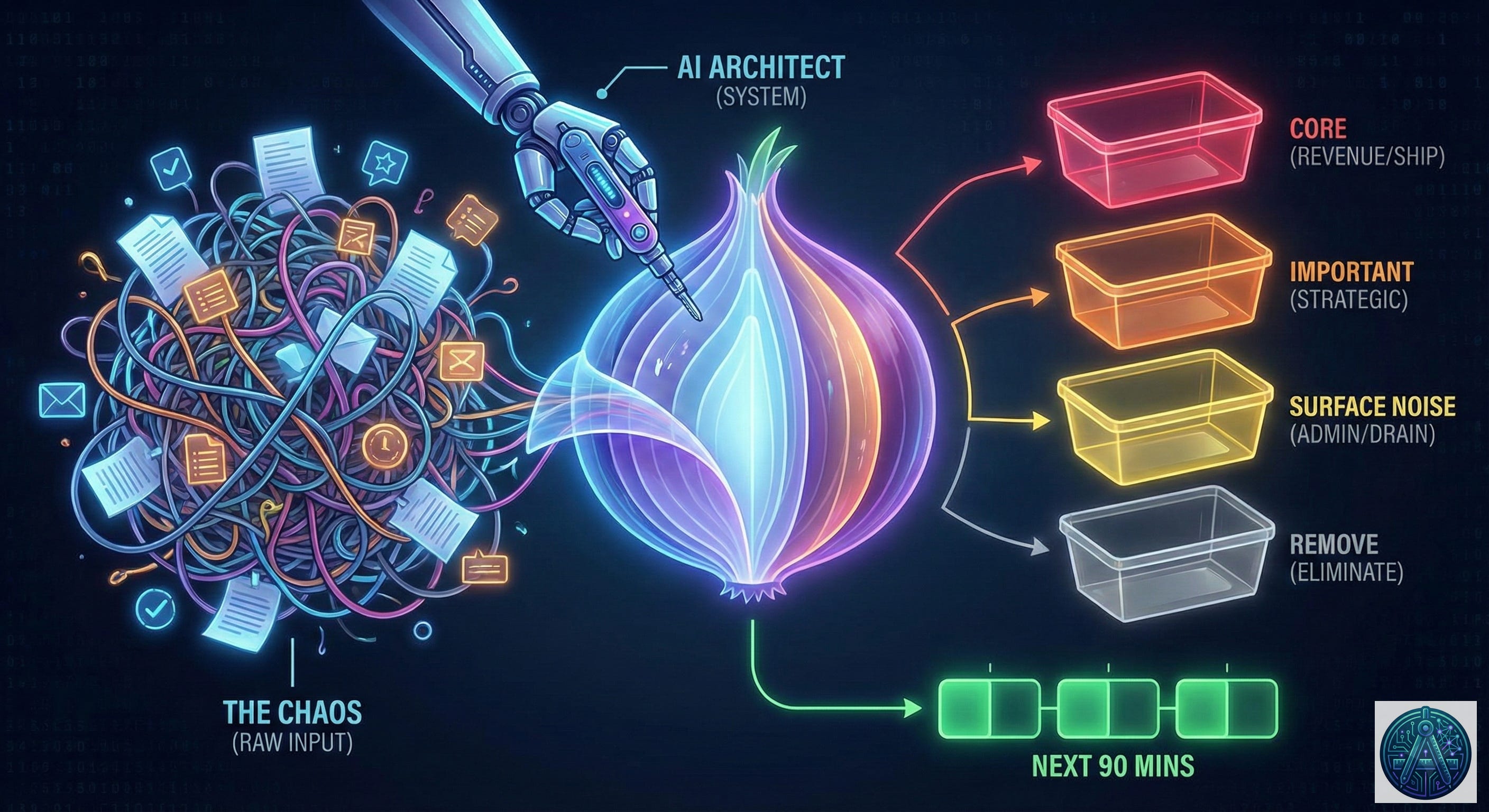
Let us look at a common productivity concept known as the “Onion Prompt.” The goal is simple: take a massive brain-dump of tasks and have the AI peel back the layers to find what actually matters right now.
The “Weak Vibe”
Here is the typical prompt someone might copy and paste from Twitter or LinkedIn. It relies entirely on hope.
User Prompt:
“I feel buried under competing tasks. Below is a snapshot of everything active. Peel back the layers and categorize items into: Core (essential progress), Important (schedule soon), Surface noise (quick admin), and Remove (close or ignore). Then identify the top 3 priorities for the next 90 minutes and tell me what I can safely let go of right now.”
[Insert messy list of 30 tasks here]
Why this fails an architectural review:
This prompt violates several of our core principles.
No Identity: Who is doing the prioritizing? A sympathetic life coach will give you a very different list than a ruthless COO. You will get an “average” prioritization.
No Context Anchors: You are asking the AI to define what “Core” means based on its generic training data. What the AI considers “Surface noise” might be a critical compliance email for your specific job. You are telling instead of showing.
Mega-Prompting: You are asking for ingestion, categorization, evaluation, and scheduling all in one breath without any checkpoints.
The Architected Vibe
Let us rebuild this prompt using our curriculum. We will inject an identity, define rigid anchors for the categories, and force a critic loop to prevent false urgency.
System Instruction:
Role: Ruthless Executive Chief of Staff.
Objective: Protect my cognitive load by aggressively filtering busywork. Your bias should always be toward elimination, not organization.
Context Anchors (Category Definitions):
Do not use generic definitions. Apply these strict criteria to every task:
CORE: Directly impacts revenue, ships a blocker for the engineering team, or prevents immediate legal/compliance risk. If it does not do one of these three, it is not Core.
IMPORTANT: Strategic work that prevents future fires but has no immediate consequence today.
SURFACE NOISE: High-context switching tasks like Slack replies, scheduling emails, or quick admin. These are draining but not high value.
REMOVE: Tasks inherited from others, ideas with no clear ROI, or “nice to haves.”
Procedure:
Ingest the raw task list provided below.
Draft Categorization: Place every item into one of the four buckets based strictly on the Anchors above.
The Critic Loop: Review your “Core” and “Important” lists. Are you mistaking mere urgency (someone is yelling) for actual importance (revenue impact)? Downgrade at least two items to “Surface Noise” or “Remove” and explain why.
Final Output: Present the finalized categories. Then, isolate exactly three tasks for the next 90 minutes block. Explicitly list five tasks that I hereby give myself permission to ignore today.
The Takeaway
The difference between the first prompt and the second is not better adjectives. The difference is structure.
The first prompt hopes the AI understands your job. The second prompt forces the AI to operate within the constraints of your reality.
Do not just copy-paste life hacks. Architect them.
Let’s build.
Kyle Paul