
Architecting the 1:1 (Case Study)
Why mainstream productivity advice fails, and how to actually engineer a management pipeline.

Welcome back to the lab.
Today, we are looking at a recent Forbes article that explores creating an “AI Workflow” to help with managing your team through performance reviews. The author correctly identifies a massive business problem: managers spend almost 50% of their time on busywork and admin, leaving little time to actually coach their teams.
The article promises that by using a specific AI workflow, a manager with a team of eight can save an entire working day of prep and post-meeting admin.
The problem is real. The promised ROI is highly desirable. But the execution is a textbook example of the “Vending Machine” mindset.
Let us tear down this mainstream advice and rebuild it using the architectural principles we have established in our previous lessons.
The Tear-Down: Where the Mainstream Fails
The workflow suggested in the article relies on duct-taping tools together without applying any strict system constraints. It is “Tool Soup,” not System Architecture.
Here is exactly where it breaks our rules:
1. The “Zero-Shot” Trap: In Step 2, the article advises the user to “Create a chat with detailed instructions on how you would like to structure your 1:1s”.
The Architect’s View: As we learned, paragraphs of instructions force the model to guess your intent. You do not give the AI “detailed instructions” on structure. You provide Context Anchors. You show it a JSON or Markdown template of a perfect 1:1 agenda and force it to match the pattern.
2. The Weak Persona: In Step 3, the workflow suggests you “Prompt ChatGPT to role-play the 1:1 scenario with you, putting it in your employee’s shoes”.
The Architect’s View: This is a weak identity deployment. Without defining the specific behavioral traits, performance history, or cognitive style of the employee, the model will simulate an “average” generic worker. You will not get realistic pushback.
3. The Missing Evaluation: In Step 5, the article says to paste your meeting transcript into ChatGPT and “ask it to provide you with a three-step action plan for you to improve your communication style”.
The Architect’s View: This accepts the AI’s first draft of feedback without a Critic Loop. It assumes the AI defaults to being an expert executive coach. If you ask a generic question, you get a generic, fortune-cookie answer.
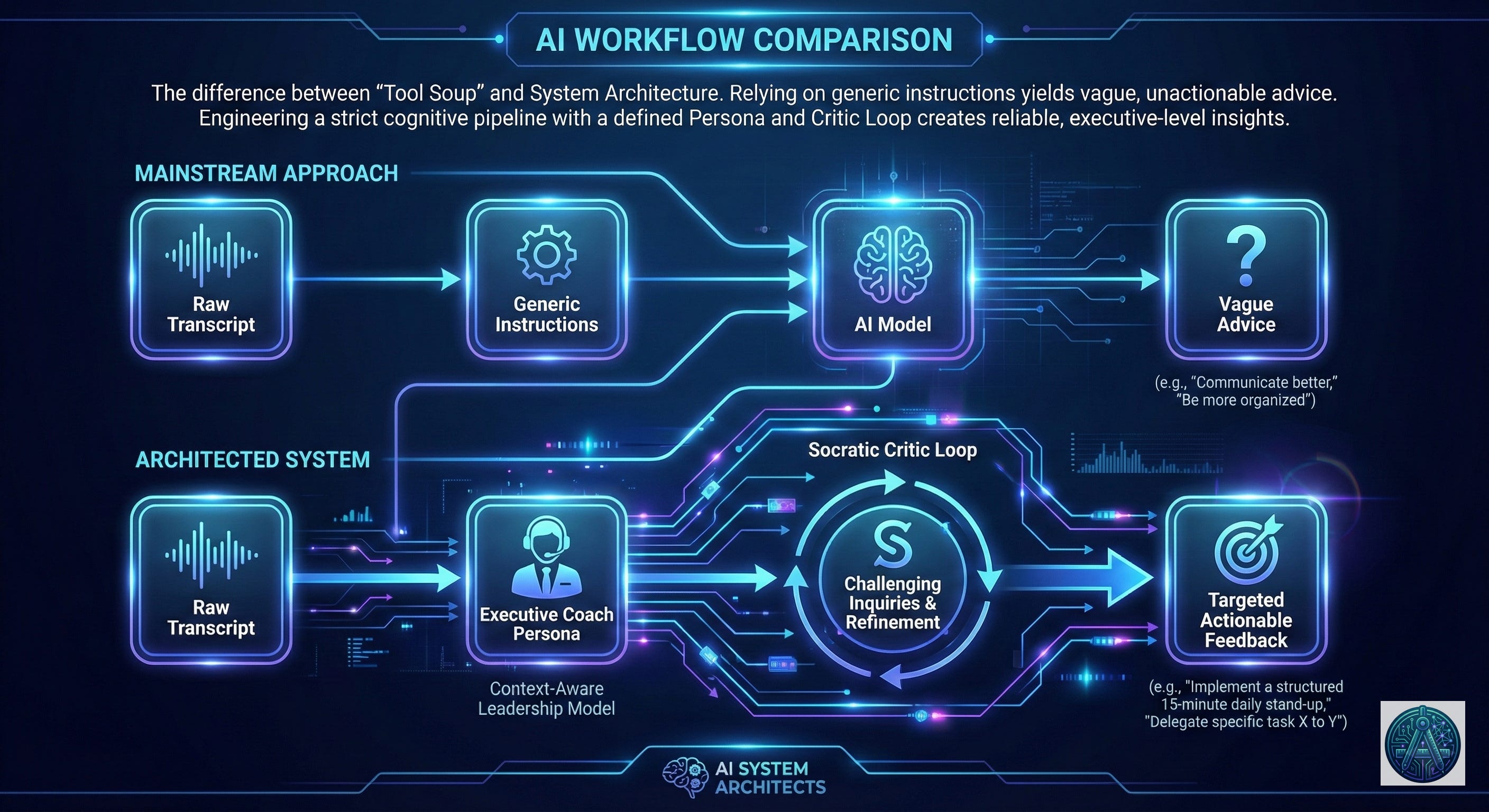
The Rebuild: Architecting the Pipeline
If we want to build a reliable pipeline for analyzing a 1:1 transcript, we must apply a Persona and switch the Cognitive Framework. We stop asking for general advice and start hunting for specific blind spots.
Use this Metaprompt structure instead:
Role: Master Executive Coach specializing in the Radical Candor framework.
Input: [Insert Meeting Transcript]
Task: Analyze my communication during this 1:1 performance review.
Cognitive Framework: Socratic Deconstruction. Do not give me generic advice or a basic summary. I need you to evaluate my performance against strict managerial standards.
Procedure:
Identify Rescue Behaviors: Highlight specific timestamps or quotes where I failed to ask a probing question and instead gave the employee the answer directly.
Evaluate Clarity: Did I clearly define what success looks like for their next milestone? If it was vague, point out exactly where my language was weak.
The Hidden Signal: Analyze the employee’s responses. Based on their word choice and brevity, what is the unspoken friction they might be feeling but not saying?
Output: Deliver this feedback in a strict bulleted list. Provide one specific alternative question I should have asked during my weakest moment in the transcript.
The Takeaway
The mainstream approach to AI is to treat it like an eager intern. You give it vague instructions and accept whatever it hands back.
The architectural approach is to treat it like a logic engine. You constrain it, you define the evaluation criteria, and you force it to prove its work.
Do not just automate your bad habits. Engineer a system that makes you a better leader.
Let’s build.
Kyle Paul